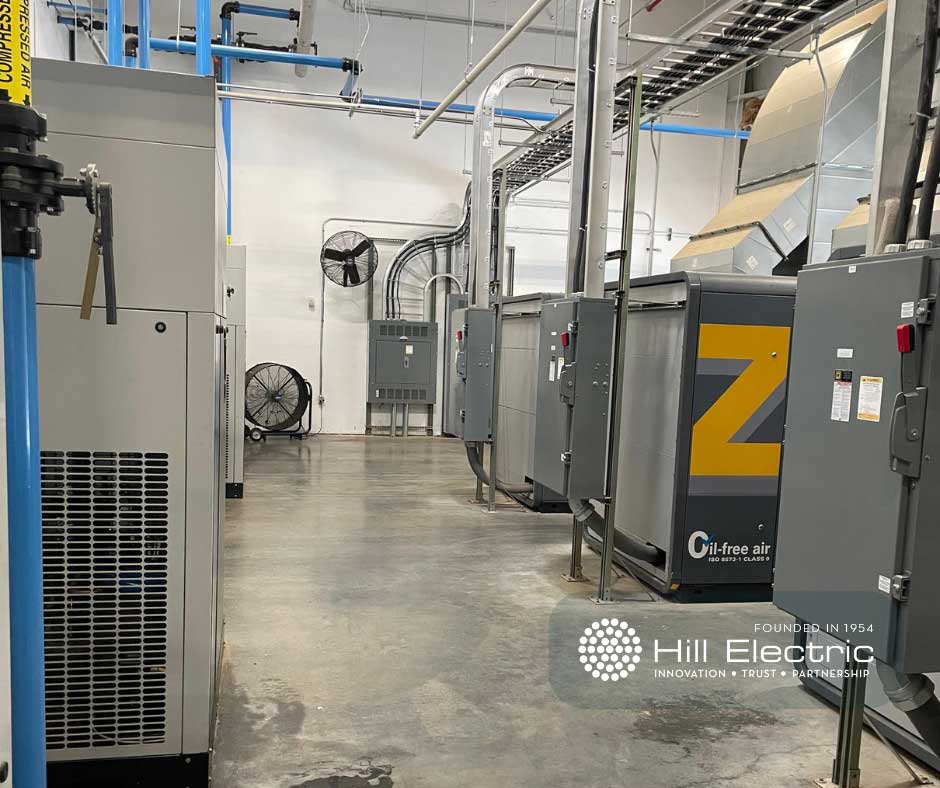
Replacing an industrial air compressor is about more than swapping out equipment; it’s about ensuring the new system integrates seamlessly with your facility’s electrical infrastructure. An experienced industrial electrical contractor, such as Hill Electric Company, brings the expertise to handle every step of the process—from evaluating power requirements and sizing feeders to installing the proper breakers and controls.
By coordinating directly with your operations team and compressor supplier, Hill Electric ensures your new equipment is professionally installed to code and ready to deliver reliable performance without disrupting production.
Why This Matters for Air Compressors
When it’s time to replace an industrial air compressor, it’s essential to consider not just the machine, but also the electrical infrastructure—and to be aware of the strict requirements set by Original Equipment Manufacturers (OEMs).
It’s common for OEMs to specify feeder sizes that are significantly higher than what code calculations might suggest. These aren’t just recommendations—OEMs will often refuse to perform the start-up or honor the warranty unless the exact specified feeder size is installed.
If you’re not working with a trusted expert, this can lead to surprises, especially when a customer purchases what they believe is an “exact replacement” compressor, only to find that updated specifications mean new electrical work is required.
What is an air compressor?
An air compressor converts electrical power into pressurized air, which is essential for pneumatic tools, automation systems, and various manufacturing processes. Essentially, it’s like a giant pump for air—it takes in normal air, squeezes it tightly, and stores it so it can power tools, machines, and other equipment when you need it.
Do I need a feeder for my air compressor?
Absolutely. Air compressors typically draw significant current. A properly sized feeder ensures stable and safe power delivery without overloading the circuit.
What is the purpose of feeder wiring for an air compressor?
Feeder wiring and properly rated conductors and breakers are designed to handle both continuous and startup loads. It ensures minimal voltage drop and prevents overheating of components.
What size feeder do I need for my air compressor?
Start by identifying the compressor’s Full Load Amps (FLA)—a rating found on the motor data plate. To determine conductor size, multiply the FLA by 1.25, aligning with electrical codes for continuous loads. Just as important, check the OEM’s requirements for fuse size, breaker type, and cable size. These specifications can be more demanding than code and, if not followed, can void your warranty or prevent the OEM from completing start-up.
What is the FLA of my compressor?
This varies by model. Always refer to the air compressor motor’s nameplate or manufacturer specs to find the precise FLA value.
What is the starting method, and why does it matter?
Different starting methods—like Direct-On-Line (DOL), star-delta, or soft-start—produce varying inrush currents. Knowing the method helps size the breaker and conductor to withstand temporary surges without nuisance tripping or damage.
How Hill Electric Delivers Reliable Solutions
Hill Electric’s industrial expertise positions them uniquely to handle compressor replacements with precision. How do we do this?
- We assess compressor FLA and starting characteristics.
- We engineer and install appropriately sized feeder wire and feeder breakers to ensure both safety and efficiency—always aligning with both code and the OEM’s latest specifications.
- Our services, including facility power distribution, industrial motor controls, and process equipment wiring, assist in seamless, code-compliant machine integration.
Replacing an air compressor without paying attention to the electrical infrastructure—or the OEM’s strict requirements—is like building on shaky ground. Under-sized feeders can cause voltage drop, overheating, and equipment failure, while oversized feeders increase cost and complexity. And when OEM specs have changed, even for a “same” model, ignoring them can delay installation and void warranty coverage.
At Hill Electric Company, the focus on industrial-grade feeder sizing, precise motor and load analysis, and robust installations ensures your compressed-air systems are reliable, safe, and efficient—and ready for OEM start-up and warranty approval.
Considering an upgrade? Reach out to Hill Electric to evaluate your system, calculate the right feeder size, and install with confidence, backed by decades of industrial electrical know-how.
Call us at Hill Electric. We are glad to answer any questions and help you with your compressor and electrical system maintenance needs.